Red Patches, Clear Answers: Reading Your Own Face After the Razor

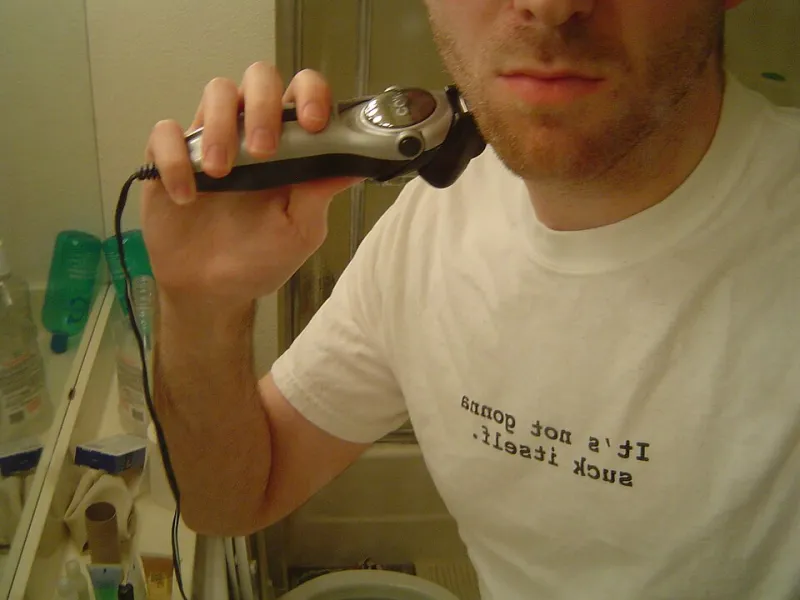
Photo: Giles Laurent, CC BY-SA 4.0, via Wikimedia Commons
You finish the shave, rinse, pat dry, look up at the bathroom mirror, and there it is. A blush of pink across the neck. A couple of hot spots along the jaw. Nothing dramatic, nothing you'd call an injury, but enough to make you wonder whether you're doing something wrong.
Here's the reassuring bit: redness is information, not a verdict. It's your skin reporting back on friction, direction, blade condition, prep, product or temperature. The useful trick is that the location narrows things down enormously. A patch on your neck and a patch on your chin are often two completely different complaints that happen to share a colour.
So let's read the map.
Quick groundwork before we go zone by zone
Post-shave redness is inflammation. The skin has been scraped, stretched and stripped of some of its outer layer, and it responds by sending blood to the area. That's a normal, temporary reaction — the sort that fades within an hour or so and leaves you with a face rather than a crime scene.
What isn't normal is redness that lingers into the next day, stings when you apply anything at all, or comes with bumps, pus or heat. We'll come back to that at the end, because it matters more than any blade recommendation.
One general point: in the UK, we're working against hard water in most of the country and central heating through the colder months. Both make skin drier and more reactive before you've even picked up the razor. If your redness got worse in November, that's not a coincidence.
The neck: usually pressure, often direction
The neck is the classic. It's also the easiest zone to misread, because people tend to blame the blade when the real problem is their hand.
Neck skin is thinner and less supported than cheek skin, and the hair grows in unpredictable directions — often in flat, swirling patterns. If you shave downwards everywhere on principle, you'll be going against the grain on roughly half of it without noticing. Add a bit of extra pressure (because it feels like it isn't cutting) and you've got a recipe for razor burn and, a week later, ingrown hairs.
What it usually means: too much pressure, too many passes, or a direction that fights the growth pattern.
Fixes worth trying: let the razor's weight do the work and consciously relax your grip. Do one pass with the grain first and stop there for a few shaves — see whether the redness drops before you reintroduce a second pass. Stretch the skin gently rather than pressing. And have a proper look at which way the neck hair actually grows; it's rarely straight down.
The jawline: chasing a closeness you don't need
The jaw and the soft area just under the chin are where the pursuit of a smooth finish costs the most. The jawbone is a curve, and razors are flat. Every time you try to get every last hair along that ridge, you're changing the blade angle mid-stroke and buffing the same square inch repeatedly.
Redness that follows the jawline in a neat line is nearly always mechanical: angle and repetition.
Fixes worth trying: shorter strokes, and accept a small amount of stubble at the very corner of the jaw. Nobody has ever noticed. Pull a face to flatten the skin rather than dragging the razor over the bone. If you're using a cartridge, rinse it more often than feels necessary — clogged blades make you press harder without realising.
The upper lip: prep, not blades
The skin above the lip is thin, close to the nose, and awkward to reach. It's also the area where lather gets wiped away by the razor before it's done its job, so you end up shaving semi-dry without meaning to.
If the redness sits in two patches either side of the philtrum, suspect insufficient lubrication and too-hot water rather than a blunt blade.
Fixes worth trying: more water in the lather than you think, worked in for longer. A merely warm flannel rather than a hot one. Short, light strokes, and rinse the razor between each one. If you use a brush, spend an extra ten seconds on the lip area before you start.
The chin: blade condition and buffing
Chin hair is dense and coarse, which means the blade meets more resistance there than anywhere else on your face. That resistance is what tempts you into repeat passes over the same spot — and it's also what dulls a blade fastest.
Redness concentrated on the chin, especially with a slightly ragged feel to the skin afterwards, tends to point at a blade that's past its best or a habit of going over the same patch three or four times.
Fixes worth trying: change the blade. Actually count your shaves rather than guessing — most people get noticeably fewer comfortable shaves than they assume. Then reduce the passes: one with, one across, and leave it there. If your chin hair is genuinely stubborn, a slightly longer warm-up (a shower, or a flannel held on the area for a minute) does more than any amount of extra pressure.
When it isn't the razor at all
Here's the part that often gets skipped in grooming advice. Not every red patch is razor burn.
Redness that comes with itchy bumps around the follicles can be folliculitis. Flaking and redness along the nasolabial folds might be seborrhoeic dermatitis. A reaction that appears minutes after you apply a post-shave product is likely the product, not the shave — fragrance is the usual offender. And if the redness is symmetrical, dry and worse in winter, your central heating and the hard water are probably doing more damage than your technique.
A sensible order of operations: strip back to the simplest routine you can manage for a fortnight — clean face, warm flannel, whatever lather you've used for years, no new scents, no acids, no scrubs. If it settles, you've found your culprit. If it doesn't, stop guessing.
The bit where we tell you to ask a professional
This site is about shaving, not dermatology. If redness is persistent, painful, spreading, weeping, or comes with swelling or pus, put the razor down and speak to a pharmacist — they're genuinely good at this and you don't need an appointment. If it doesn't settle, keeps coming back in the same place, or is affecting your confidence, see your GP.
No bottle on a shelf is a substitute for that. A new £30 post-shave balm is not a diagnosis, and buying one to avoid a ten-minute conversation is the most expensive way to stay uncomfortable.
A short reset worth trying
If you want something practical to do this week: shave every other day, one pass with the grain only, fresh blade, warm rather than hot water, no new products, and a plain unscented moisturiser afterwards once the skin has cooled. Give it seven to ten days. Most people find the map redraws itself fairly quickly once the pressure comes off — literally.
Your face has been telling you something all along. It's just been doing it in red.